
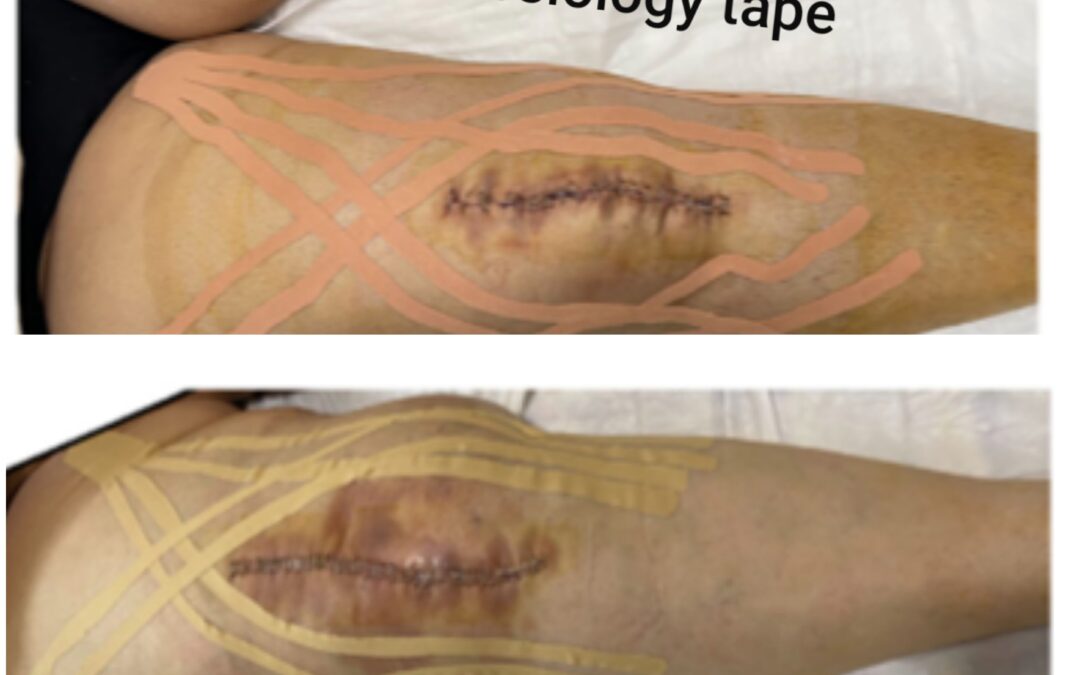
A Turkish study investigated the effect of kinesiology tape on postoperative pain and oedema following total knee arthroplasties (TKA). The study compared kinesiology tape with a non-elastic sham tape to consider whether the elasticity of the kinesiology tape improved pain, oedema, range of motion (ROM), and function early in the postoperative period. The taping, whether true or sham, was applied in conjunction with typical conservative post-operative physiotherapy.
The study included 192 patients randomized to one of three groups: kinesiology tape, non-elastic sham tape, or a control group, meaning there were 64 patients in each group. The TKAs were performed by the same surgeon, utilising the same prosthesis and surgical approach. All patients followed the same post-operative medication regime and utilized anti-embolism stockings. All patients had cryotherapy and used CPM machines daily.
For the kinesiology and sham-taping patients, the tape was applied on the first day postoperatively and then again on the third day postoperatively. Patients were discharged on the fourth postoperative day, and they were asked to remove the tape on day seven.
The patients were evaluated preoperatively, on day one, post-op, day three, and day ten. All measurements were done by the same investigator, who was blinded to group allocation. Pain was measured with the 0 to 10 VAS scale, while circumferential limb measurements were taken to measure oedema and compared with the participants’ pre-operative measurements. ROM was measured with a goniometer, and the Oxford Knee Score was used to evaluate the patient’s functional condition.
The study found a statistically significant difference in oedema in the kinesiology taping group at day ten compared to the sham and control groups. There were no significantly different results for pain, function, or knee ROM between groups, with all of them improving over the postoperative period, as expected. Interestingly, the sham taping group had less movement range on day ten than the other groups. This may be because the sham tape was non-elastic and may have limited ROM.
The findings of this study regarding the improvement in oedema following kinesiology tape application post-operatively are consistent with the findings of several other studies. This study did not find an effect on pain with the taping groups, and that may be due to the severity of post-surgical pain compared with the severity of pain in other musculoskeletal injuries where we may see some pain relief, such as ankle sprains, etc. With TKA surgery involving cutting bone material to fit the prosthesis, it is probably fairly optimistic to believe that tape on the skin could reduce the pain experienced! It would be interesting to have a longer follow-up period to see if that improved the pain experience and whether it would positively affect ROM. Perhaps ten days post-operatively is too short to find improvements in these parameters after such significant surgery? Typically, we would associate a reduced oedema with increased ROM, so perhaps this would have been more obvious over a longer time frame.
This study shows that using kinesiology tape post-operatively can be a safe and effective way to reduce oedema in post-surgical patients. It contributes to the growing body of evidence supporting this use of kinesiology tape.
Cakmak, M. & Cigdem-Karacay, B. (2023). The effect of Kinesio taping on edema, pain, and functionality after total knee arthroplasty: A randomised sham-controlled double blinded clinical study. Journal of Orthopaedic Science https://doi.org/10.1016/j.jos.2023.05.012